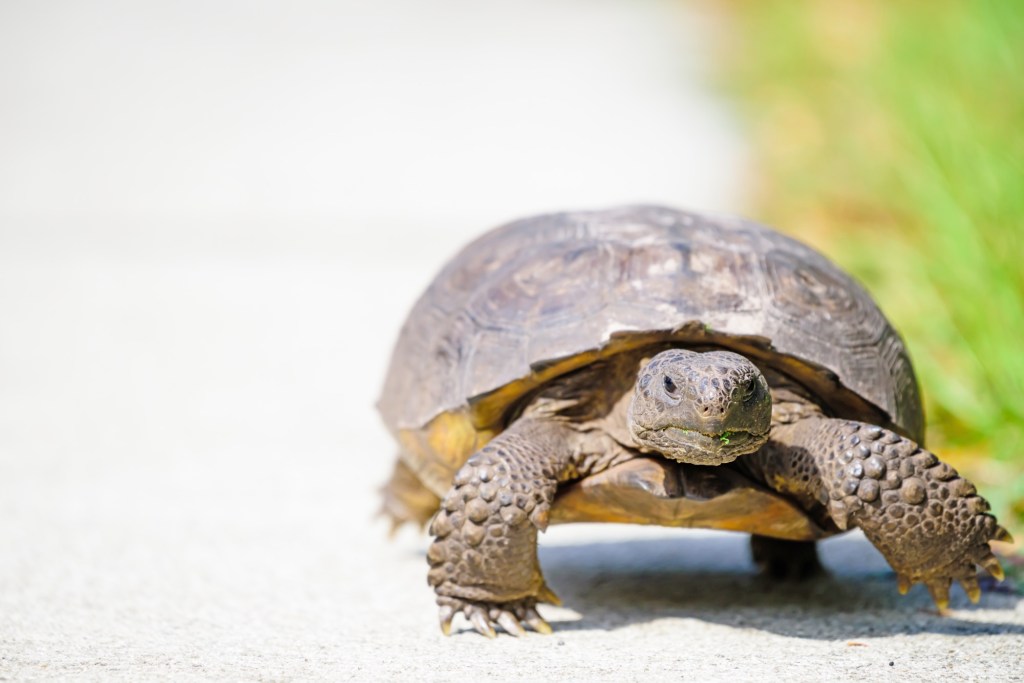


A gopher tortoise’s habitat is generally sandy, bright and sunny, full of short herbaceous plants they like to eat, and often in a pine flatwood or savannah. Fire is a very important element in a gopher tortoise’s habitat, but we’ll get to that a little later. A gopher tortoise will spend its entire life in a habitat that’s less than a few square miles. They usually stick around their burrows and only venture out about 160 feet away to find food.
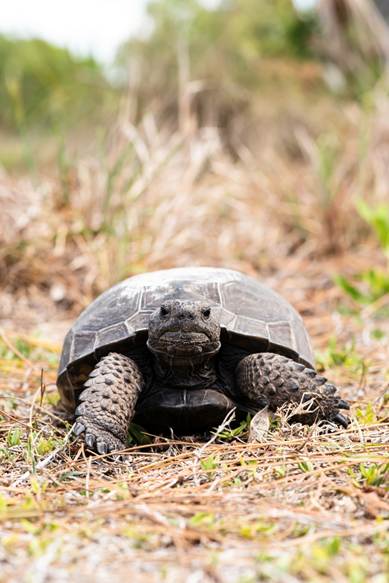
“Every organism is part of a habitat.”
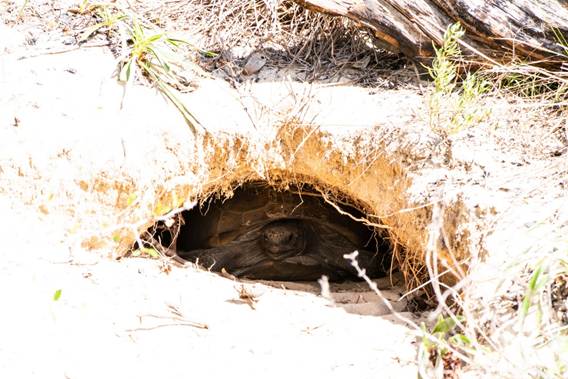
Gopher tortoises are a keystone species. This means that they help other species to live. Their burrows are amazing feats of tortoise engineering. They can be up to forty feet long and ten feet deep! Due to this, their burrows can be home to 350 other animals! Some of these animals are threatened or endangered, so it’s very important to protect these burrows! Some examples of animals that share the burrows are the eastern indigo snake, gopher frog, eastern diamond back rattlesnake, Florida mouse, burrowing owl, great horned owl, and many invertebrates such as the gopher cricket and gopher scarab beetle. These burrows not only provide a home from these creatures, but they also offer protection from fire, which is a vital resource in the type of ecosystem in which these animals reside.
“Two essential and related processes of change are disturbance and succession.”
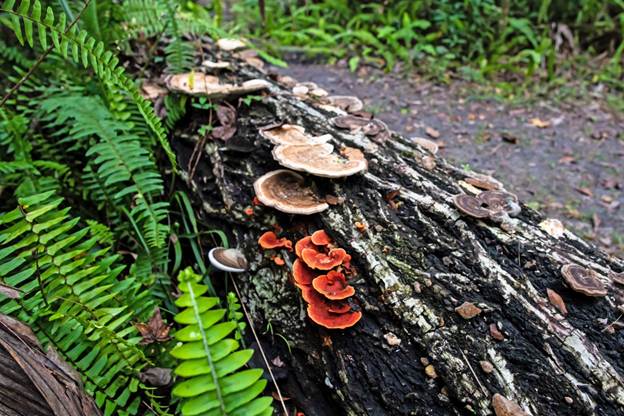
Disturbance and succession are vital processes that help maintain vitality in an ecosystem. Ecosystems on earth exist in a constant state of change. They’re always evolving and changing, not only with the seasons, but with events the cause disturbances, which are often very destructive. Some examples of this are hurricanes, floods, severe winds, fire, lightning storms, and tornadoes. While these events seem catastrophic, and they often are for humans, they are a natural and necessary part of a healthy ecosystem. Like most things in life, the only constant is change. In a healthy environment, there are destructive events that clear away the old and make way for the new. An example of this is a large tree falling in a forest. When the tree falls, it creates space in the canopy above and allows light to reach the forest floor. As a result, it encourages growth of small trees that otherwise wouldn’t receive enough sunligh due to the forest canopy blocking out the sun. These falled trees also encourage many types of small plants and fungi to grow on and around them as they degrade and decompose. They also fertilize the soil. This is all part of life. Fallen trees make way for new life.
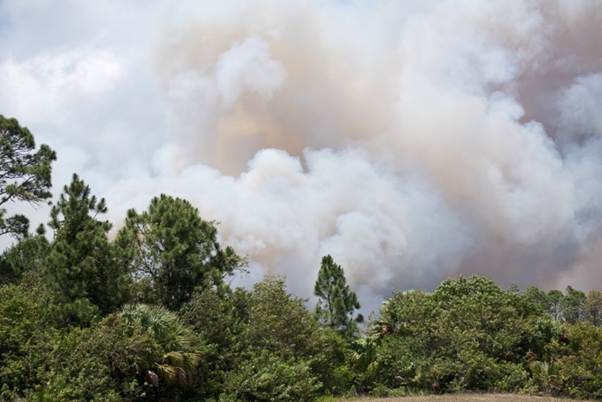
The same is true of fire, particularly in a pine forest. Ecosystems know what to do to maintain their status. A pine forest remains a pine forest because nature ensures the small shrubby deciduous trees don’t get an opportunity to grow into giant trees, causing the pine forest to become a hardwood hammock. Fires also clear underbrush, allowing many amazing wildflowers to bloom that otherwise would not. There are also certain pine trees that cannot reproduce without fire as the heat causes the pinecones to open, releasing seeds. Let’s go back to the gopher tortoise. Their burrows are amazing because many animals retreat to them when a fire comes through the area. And the fire causes the ground to be cleared of larger, dryer plant life to make way for the shorter, juicier varieties the gopher tortoise enjoys eating.
Robertson, M. (2017). What is Sustainability? In Sustainability Principles and Practices (2nd ed., pp. 3–3), Routledge Taylor and Francis Group.
 RH Photo Adventures
Leave a comment